Image Embedding Clustering with Feluda
This notebook demonstrates how to use the feluda to extract image embeddings, reduce their dimensions, and cluster them. It includes:
Setting up Feluda and its operators.
Using image data extracted from the UCF101 video dataset by extracting first frames from videos. We are using this for demo, but can be replaced with any image dataset.
Generating image embeddings using feluda ResNet18 image-vec-rep operator.
Reducing dimensions using Feluda’s dimension-reduction operator.
Using Feluda’s cluster-embeddings operator to cluster images.
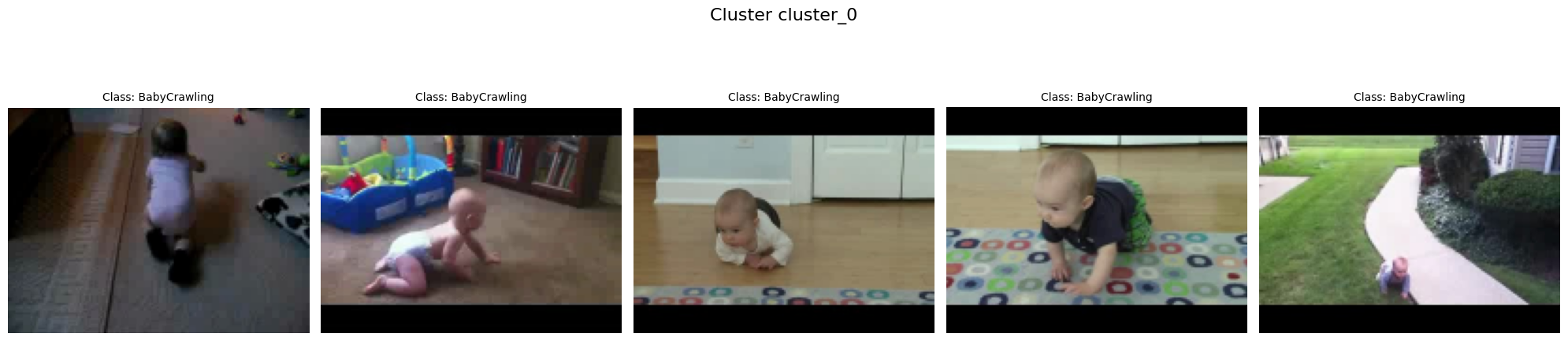
Visualizing the clusters with image thumbnails.


Install dependencies
%%time
import sys

IN_COLAB = "google.colab" in sys.modules
print("Running Notebook in Google Colab" if IN_COLAB else "Running Notebook locally")

if IN_COLAB:
    # Since Google Colab has preinstalled libraries like tensorflow and numba, we create a folder called feluda_custom_venv and isolate the environment there.
    # This is done to avoid any conflicts with the preinstalled libraries.
    %pip install uv
    !mkdir -p /content/feluda_custom_venv
    !uv pip install --target=/content/feluda_custom_venv --prerelease allow feluda feluda-image-vec-rep feluda-dimension-reduction feluda-cluster-embeddings opencv-python matplotlib > /dev/null 2>&1

    sys.path.insert(0, "/content/feluda_custom_venv")
else:
    !uv pip install feluda feluda-image-vec-rep feluda-dimension-reduction feluda-cluster-embeddings opencv-python matplotlib > /dev/null 2>&1
import os
import tarfile
from pathlib import Path

import cv2
import matplotlib.pyplot as plt
import numpy as np
from huggingface_hub import hf_hub_download
from tqdm.notebook import tqdm

from feluda.factory import ImageFactory
We’ll use three operators for this example:
ImageVecRep for extracting image embeddings using ResNet18
DimensionReduction for reducing high-dimensional embeddings to 2D
ClusterEmbeddings for clustering the reduced embeddings
from feluda.operators import ClusterEmbeddings, DimensionReduction, ImageVecRep

# Initialize operators
image_vec_operator = ImageVecRep()
dimension_reduction_operator = DimensionReduction("umap", {
    "n_components": 2,
    "n_neighbors": 15,
    "min_dist": 0.1,
    "random_state": 42
})
cluster_operator = ClusterEmbeddings()
UMAP model successfully initialized
Data Preparation
dataset_name = "UCF101_subset/train"
hf_dataset_identifier = "sayakpaul/ucf101-subset"
filename = "UCF101_subset.tar.gz"

print("Downloading and extracting dataset...")
file_path = hf_hub_download(
    repo_id=hf_dataset_identifier, filename=filename, repo_type="dataset"
)

with tarfile.open(file_path) as t:
    t.extractall(".")
print(f"Dataset extracted to {dataset_name}")
Downloading and extracting dataset...
Dataset extracted to UCF101_subset/train
/var/folders/4p/bw6h5x8x1nb_17vsgfc12dz00000gn/T/ipykernel_7812/653585941.py:12: DeprecationWarning: Python 3.14 will, by default, filter extracted tar archives and reject files or modify their metadata. Use the filter argument to control this behavior.
  t.extractall(".")
# Create thumbnails directory for extracted images
thumbnail_dir = Path("image_thumbnails")
thumbnail_dir.mkdir(exist_ok=True)
def extract_image_from_video(video_path: str, save_path: str) -> str | None:
    """Extract and save the first frame from the video as an image.

    Args:
        video_path: Path to the video file
        save_path: Directory to save the extracted image

    Returns:
        Path to the saved image or None if extraction failed
    """
    cap = cv2.VideoCapture(video_path)
    ret, frame = cap.read()  # Read the first frame

    if ret:
        image_filename = os.path.basename(video_path).replace(".avi", "_frame.jpg")
        image_path = os.path.join(save_path, image_filename)
        cv2.imwrite(image_path, frame)  # Save the frame as a JPEG
        cap.release()
        return image_path  # Return the path to the saved image

    cap.release()
    return None
Processing videos and extracting image embeddings
operator_parameters = []
sub_folder_name = os.listdir(f"{dataset_name}")

for class_dir in tqdm(sub_folder_name, desc="Processing classes"):
    temp_list = os.listdir(os.path.join(dataset_name, class_dir))

    # Process up to 8 images per class
    image_count = 0
    for video_file in temp_list:
        if video_file == "UCF101" or image_count >= 8:
            continue

        video_full_path = os.path.join(dataset_name, class_dir, video_file)

        try:

            image_path = extract_image_from_video(video_full_path, thumbnail_dir)

            if image_path is None:
                continue


            image_obj = ImageFactory.make_from_file_on_disk(image_path)

            # Extract image embedding using ResNet18
            embedding = image_vec_operator.run(image_obj)

            operator_parameters.append(
                {
                    "payload": image_path,
                    "embedding": embedding.tolist(),
                    "class": class_dir,
                }
            )

            image_count += 1
        except Exception as e:
            print(f"Error processing {video_full_path}: {e}")
            continue

print(f"Successfully processed {len(operator_parameters)} images")
Successfully processed 80 images
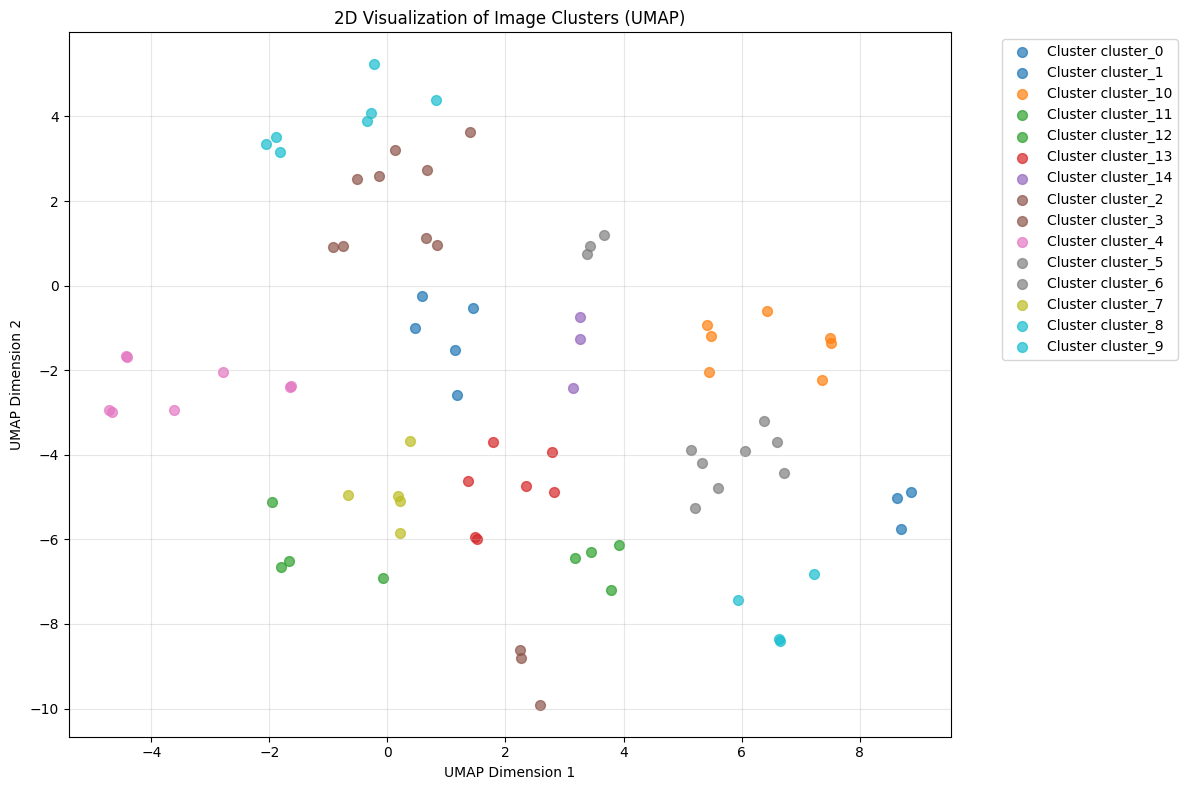
Reduce the 512-dimensional ResNet18 embeddings to 2D for visualization
reduced_embeddings = dimension_reduction_operator.run(operator_parameters)
/Users/omkarkabde/Desktop/feluda/.venv/lib/python3.13/site-packages/sklearn/utils/extmath.py:350: RuntimeWarning: divide by zero encountered in matmul
  Q, _ = normalizer(A @ Q)
/Users/omkarkabde/Desktop/feluda/.venv/lib/python3.13/site-packages/sklearn/utils/extmath.py:350: RuntimeWarning: overflow encountered in matmul
  Q, _ = normalizer(A @ Q)
/Users/omkarkabde/Desktop/feluda/.venv/lib/python3.13/site-packages/sklearn/utils/extmath.py:350: RuntimeWarning: invalid value encountered in matmul
  Q, _ = normalizer(A @ Q)
/Users/omkarkabde/Desktop/feluda/.venv/lib/python3.13/site-packages/sklearn/utils/extmath.py:351: RuntimeWarning: divide by zero encountered in matmul
  Q, _ = normalizer(A.T @ Q)
/Users/omkarkabde/Desktop/feluda/.venv/lib/python3.13/site-packages/sklearn/utils/extmath.py:351: RuntimeWarning: overflow encountered in matmul
  Q, _ = normalizer(A.T @ Q)
/Users/omkarkabde/Desktop/feluda/.venv/lib/python3.13/site-packages/sklearn/utils/extmath.py:351: RuntimeWarning: invalid value encountered in matmul
  Q, _ = normalizer(A.T @ Q)
/Users/omkarkabde/Desktop/feluda/.venv/lib/python3.13/site-packages/sklearn/utils/extmath.py:355: RuntimeWarning: divide by zero encountered in matmul
  Q, _ = qr_normalizer(A @ Q)
/Users/omkarkabde/Desktop/feluda/.venv/lib/python3.13/site-packages/sklearn/utils/extmath.py:355: RuntimeWarning: overflow encountered in matmul
  Q, _ = qr_normalizer(A @ Q)
/Users/omkarkabde/Desktop/feluda/.venv/lib/python3.13/site-packages/sklearn/utils/extmath.py:355: RuntimeWarning: invalid value encountered in matmul
  Q, _ = qr_normalizer(A @ Q)
/Users/omkarkabde/Desktop/feluda/.venv/lib/python3.13/site-packages/sklearn/utils/extmath.py:577: RuntimeWarning: divide by zero encountered in matmul
  B = Q.T @ M
/Users/omkarkabde/Desktop/feluda/.venv/lib/python3.13/site-packages/sklearn/utils/extmath.py:577: RuntimeWarning: overflow encountered in matmul
  B = Q.T @ M
/Users/omkarkabde/Desktop/feluda/.venv/lib/python3.13/site-packages/sklearn/utils/extmath.py:577: RuntimeWarning: invalid value encountered in matmul
  B = Q.T @ M
/Users/omkarkabde/Desktop/feluda/.venv/lib/python3.13/site-packages/sklearn/utils/extmath.py:590: RuntimeWarning: divide by zero encountered in matmul
  U = Q @ Uhat
/Users/omkarkabde/Desktop/feluda/.venv/lib/python3.13/site-packages/sklearn/utils/extmath.py:590: RuntimeWarning: overflow encountered in matmul
  U = Q @ Uhat
/Users/omkarkabde/Desktop/feluda/.venv/lib/python3.13/site-packages/sklearn/utils/extmath.py:590: RuntimeWarning: invalid value encountered in matmul
  U = Q @ Uhat
# Prepare data for clustering (using the reduced embeddings)
clustering_data = []
for i, item in enumerate(reduced_embeddings):
    clustering_data.append({
        "payload": item["payload"],
        "embedding": item["reduced_embedding"],
        "class": operator_parameters[i]["class"]
    })

print("Clustering image embeddings...")
n_clusters = 15  # Number of clusters to create
clusters = cluster_operator.run(
    clustering_data, n_clusters=n_clusters, modality="audio"  # Using audio modality for kmeans clustering
)

# Sort clusters by label for consistent display
clusters = {key: clusters[key] for key in sorted(clusters)}
Clustering image embeddings...
def load_image(image_path):
    """Load an image from the specified path.

    Args:
        image_path: Path to the image file

    Returns:
        Loaded image or None if not found
    """
    if os.path.exists(image_path):
        return cv2.imread(image_path)
    print(f"Image not found: {image_path}")
    return None
# Create scatter plot of reduced embeddings
plt.figure(figsize=(12, 8))

# Prepare data for scatter plot
cluster_colors = plt.cm.tab10(np.linspace(0, 1, len(clusters)))
cluster_labels = list(clusters.keys())

for i, (cluster_label, image_paths) in enumerate(clusters.items()):
    if not image_paths:
        continue

    # Get reduced embeddings for this cluster
    cluster_embeddings = []
    cluster_classes = []

    for image_path in image_paths:
        # Find the corresponding reduced embedding
        for item in reduced_embeddings:
            if item["payload"] == image_path:
                cluster_embeddings.append(item["reduced_embedding"])
                # Find the class name
                for orig_item in operator_parameters:
                    if orig_item["payload"] == image_path:
                        cluster_classes.append(orig_item["class"])
                        break
                break

    if cluster_embeddings:
        cluster_embeddings = np.array(cluster_embeddings)
        plt.scatter(cluster_embeddings[:, 0], cluster_embeddings[:, 1],
                   c=[cluster_colors[i]], label=f"Cluster {cluster_label}",
                   alpha=0.7, s=50)

plt.xlabel("UMAP Dimension 1")
plt.ylabel("UMAP Dimension 2")
plt.title("2D Visualization of Image Clusters (UMAP)")
plt.legend(bbox_to_anchor=(1.05, 1), loc='upper left')
plt.grid(True, alpha=0.3)
plt.tight_layout()
plt.show()
print("Cluster Analysis:")
print("=" * 50)

for cluster_label, image_paths in clusters.items():
    num_images = len(image_paths)
    print(f"\nCluster {cluster_label} ({num_images} images):")

    # Create a subplot for each image in the cluster
    fig, axes = plt.subplots(1, max(1, num_images), figsize=(20, 5))
    # Handle case where there's only one image in a cluster
    if num_images == 1:
        axes = [axes]

    # Count classes in this cluster
    class_counts = {}
    for i, image_path in enumerate(image_paths):
        for item in operator_parameters:
            if item["payload"] == image_path:
                class_name = item["class"]
                image = load_image(image_path)
                if image is not None:
                    # Resize and convert color format
                    image = cv2.cvtColor(
                        cv2.resize(image, (160, 120)), cv2.COLOR_BGR2RGB
                    )
                    axes[i].imshow(image)
                    axes[i].set_title(f"Class: {class_name}", fontsize=10)
                    axes[i].axis("off")

                class_counts[class_name] = class_counts.get(class_name, 0) + 1
                break

    # Display class distribution
    for class_name, count in sorted(class_counts.items()):
        print(f"  - {class_name}: {count} images")

    plt.suptitle(f"Cluster {cluster_label}", fontsize=16)
    plt.tight_layout()
    plt.subplots_adjust(top=0.85)
    plt.show()
Cluster Analysis:
==================================================

Cluster cluster_0 (5 images):
  - BabyCrawling: 5 images
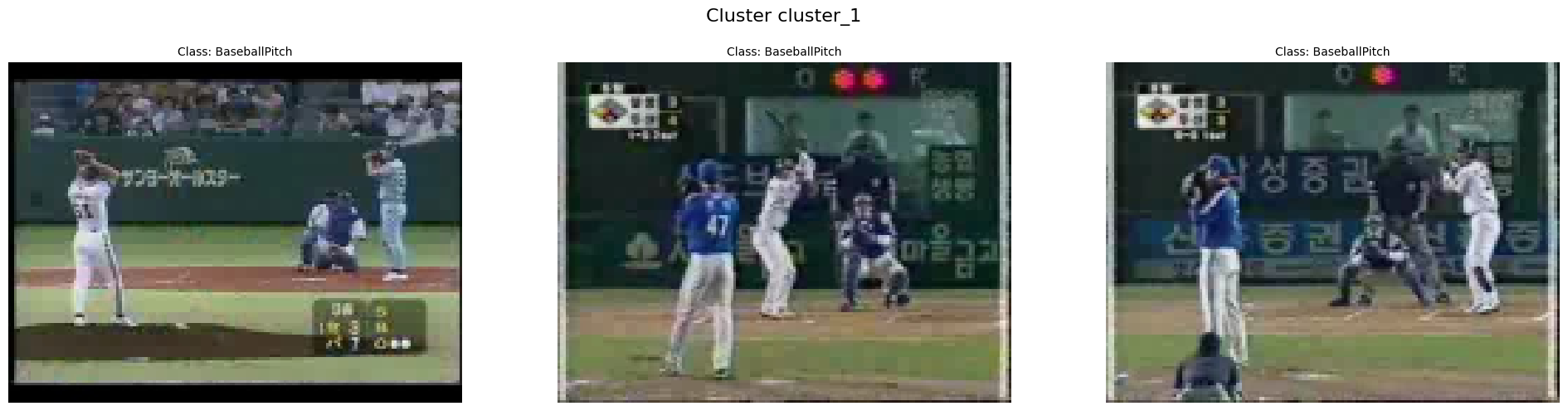
Cluster cluster_1 (3 images):
  - BaseballPitch: 3 images
Cluster cluster_10 (7 images):
  - BalanceBeam: 7 images

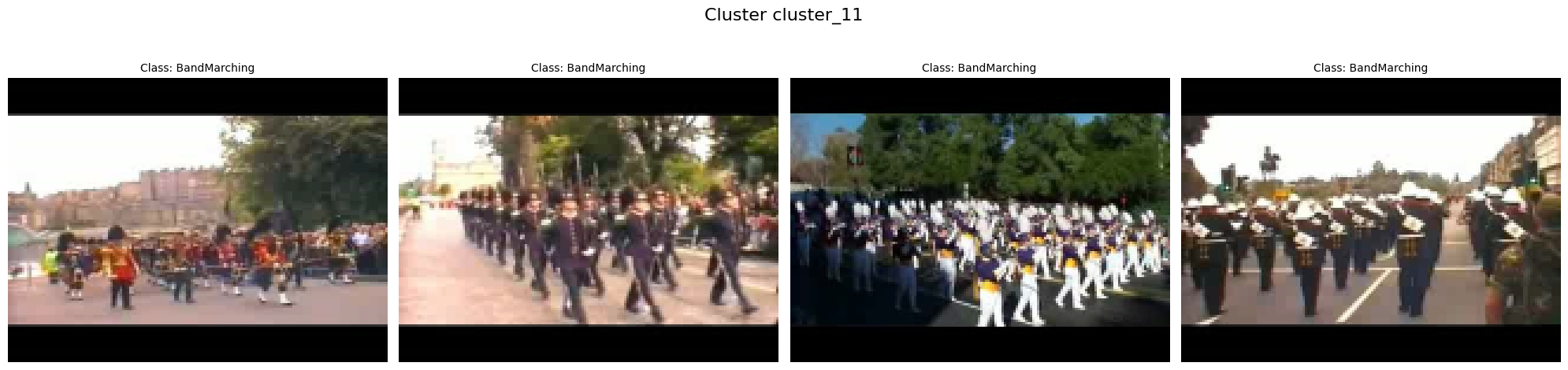
Cluster cluster_11 (4 images):
  - BandMarching: 4 images
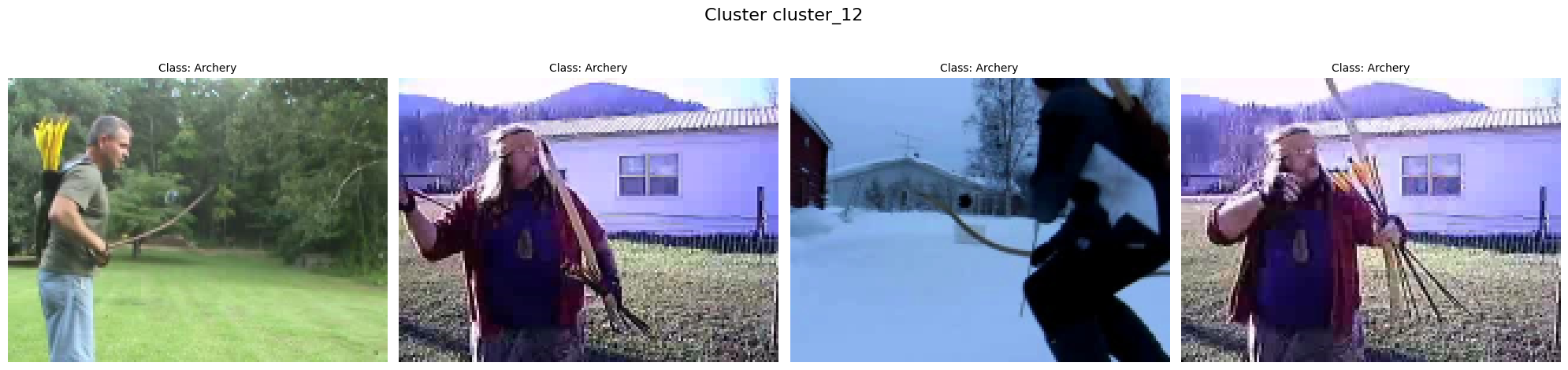
Cluster cluster_12 (4 images):
  - Archery: 4 images
Cluster cluster_13 (7 images):
  - Archery: 3 images
  - BandMarching: 1 images
  - Basketball: 3 images

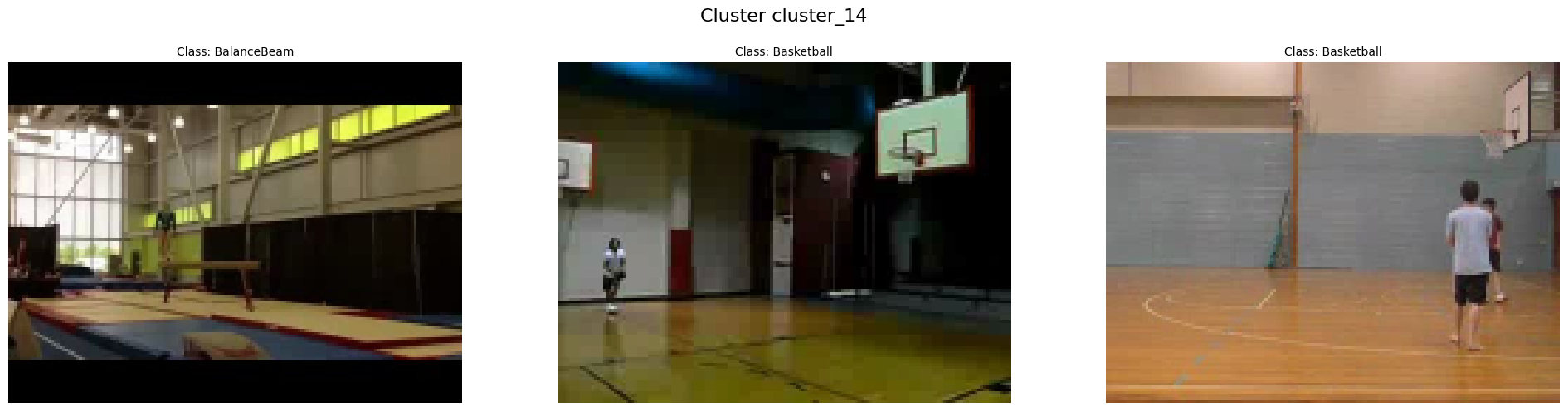
Cluster cluster_14 (3 images):
  - BalanceBeam: 1 images
  - Basketball: 2 images
Cluster cluster_2 (9 images):
  - ApplyEyeMakeup: 5 images
  - ApplyLipstick: 4 images

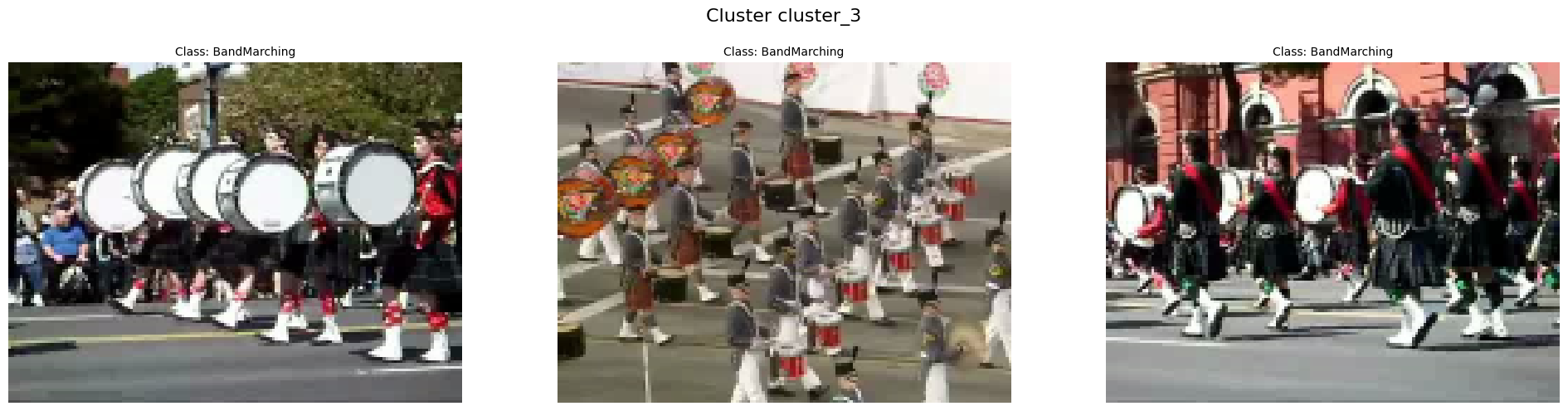
Cluster cluster_3 (3 images):
  - BandMarching: 3 images
Cluster cluster_4 (8 images):
  - BenchPress: 8 images

Cluster cluster_5 (8 images):
  - BasketballDunk: 8 images

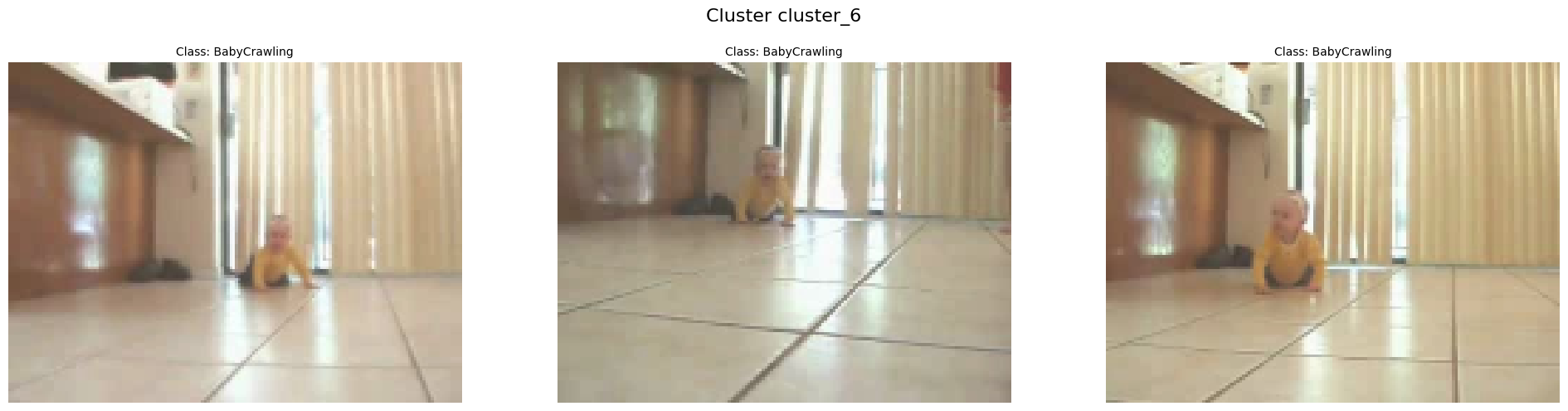
Cluster cluster_6 (3 images):
  - BabyCrawling: 3 images
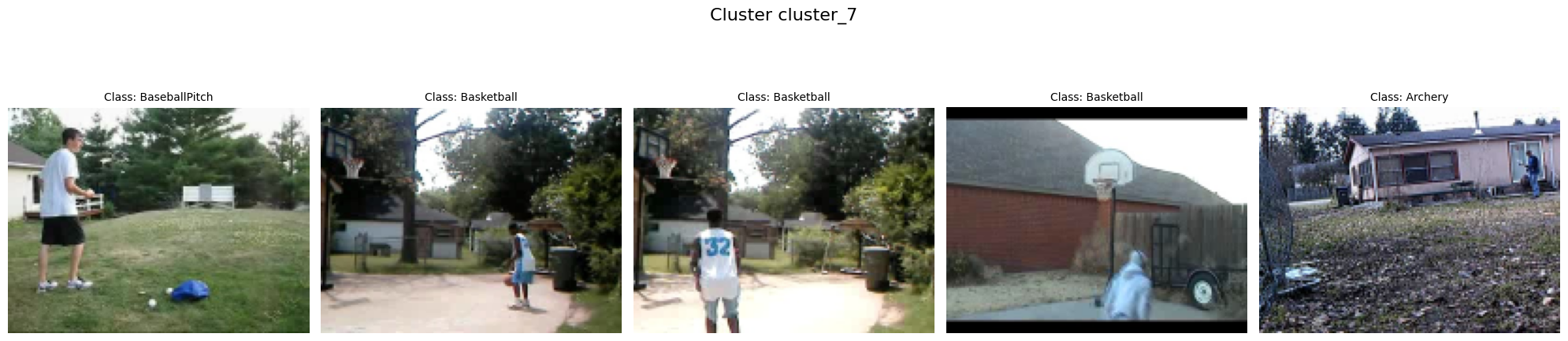
Cluster cluster_7 (5 images):
  - Archery: 1 images
  - BaseballPitch: 1 images
  - Basketball: 3 images
Cluster cluster_8 (7 images):
  - ApplyEyeMakeup: 3 images
  - ApplyLipstick: 4 images

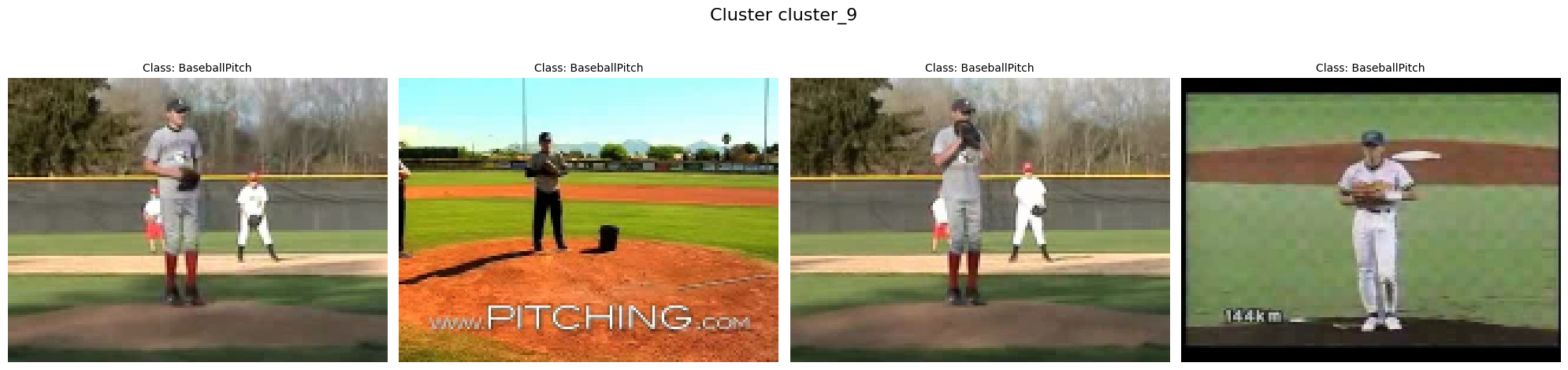
Cluster cluster_9 (4 images):
  - BaseballPitch: 4 images
Clean up dataset and operators
import shutil

# Remove thumbnail directory
if os.path.exists(thumbnail_dir):
    shutil.rmtree(thumbnail_dir)
    print(f"Removed {thumbnail_dir}")

# Remove dataset directory
if os.path.exists("UCF101_subset"):
    shutil.rmtree("UCF101_subset")
    print("Removed UCF101_subset")

# Remove downloaded dataset file
if os.path.exists(file_path):
    os.remove(file_path)
    print("Removed dataset")

# Cleanup operators
image_vec_operator.cleanup()
dimension_reduction_operator.cleanup()
cluster_operator.cleanup()
Removed image_thumbnails
Removed UCF101_subset
Removed dataset